Columbia University & GENI: Embedding Real-time Substrate Measurements for Cross-layer Communications (ERM)
Global Environment for Network Innovations (GENI) News
Global Environment for Network Innovations (GENI) Front Page
Columbia University Department of Electrical Engineering News & Events
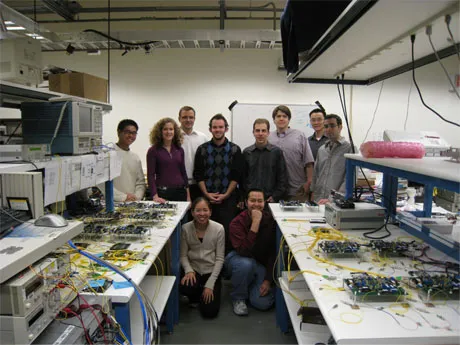
The GENI ERM team at Columbia University, led by Prof. Keren Bergman, Director of the Lightwave Research Laboratory, is creating innovative cross-layer measurement capabilities that will help free GENI researchers from the constraints of today's strictly layered Internet architecture.
By providing deeper exposure to physical layer measurement and protocol information, the ERM team will help enable GENI researchers to realize well instrumented experiments supporting new network architectures that cut across today's protocol layers. The ERM team has developed initial specifications for cross-layer communications that will allow bi-directional information exchange between protocol layers and enable holistic optimization of the network stack from optical network substrates all the way up to the application, and are now working with other GENI prototyping projects to integrate their design into the overall GENI control and measurement framework.
To enable this top-to-bottom communication, the ERM team is developing GENI-compatible, real-time embedded measurement capabilities; enabling deeper exposure and transparency to network substrates for cross-layer information exchange and user access; and integrating their prototypes with GENIs ORCA control plane to dynamically monitor optical substrate performance and allow for cross-layer control and management decisions based on the optical layer configuration and performance.
Prof. Bergman's team has already achieved several important milestones. The team first evaluated the GENI system designs capabilities to embed real-time measurements and assessed requirements for real-time user access to data measurements across a diverse set of heterogeneous technologies. Then they developed two sets of specifications; one for supporting real-time measurements within the network substrate and another for network protocols that access cross-layer measurements. They have also developed models using the ns-2 simulator to quantify the performance improvements that their techniques enable. Finally, the team has proposed a Unified Measurement Framework (UMF) that includes well-defined interfaces between the GENI control plane and measurement devices.
Now the ERM team is collaborating with the GENI prototype projects at the Renaissance Computing Institute (RENCI), Duke University, and the University of Houston for potential integration of their real-time measurement system into the ORCA-BEN control framework. Before the end of the year, the ERM team expects to contribute an experimental use case to GENI working groups to further validate the proposed cross-layer communications schemes.
GENI Mission & Vision
Global Environment for Network Innovations (GENI)
The Global Environment for Network Innovations (GENI) is a unique virtual laboratory for at-scale networking experimentation where the brightest minds unite to envision and create new possibilities of future internets. The GENI mission is to:
-
open the way for transformative research at the frontiers of network science and engineering; and
-
inspire and accelerate the potential for groundbreaking innovations of significant socio-economic impact.
About the Global Environment for Network Innovations (GENI)
Global Environment for Network Innovations (GENI)
GENI, a virtual laboratory for exploring future internets at scale, creates major opportunities to understand, innovate and transform global networks and their interactions with society. Dynamic and adaptive, GENI opens up new areas of research at the frontiers of network science and engineering, and increases the opportunity for significant socio-economic impact. GENI will:
-
support at-scale experimentation on shared, heterogeneous, highly instrumented infrastructure;
-
enable deep programmability throughout the network, promoting innovations in network science, security, technologies, services and applications; and
-
provide collaborative and exploratory environments for academia, industry and the public to catalyze groundbreaking discoveries and innovation.