
Columbia Engineering featured an article about our recent Nature Photonics paper “3D Photonics for Ultra-Low Energy, High Bandwidth-Density Chip Data Links”. In this paper, the Lightwave Research Group demonstrated "a 3D photonic-electronic platform that achieves unprecedented energy efficiency and bandwidth density, paving the way for next-generation AI hardware."
We reported a bandwidth of 800 Gb/s, with an energy consumption of only 120 femtojoules per bit. The package achieves a bandwidth density of 5.3 Tb/s/mm², which exceeds the current state-of-the-art.

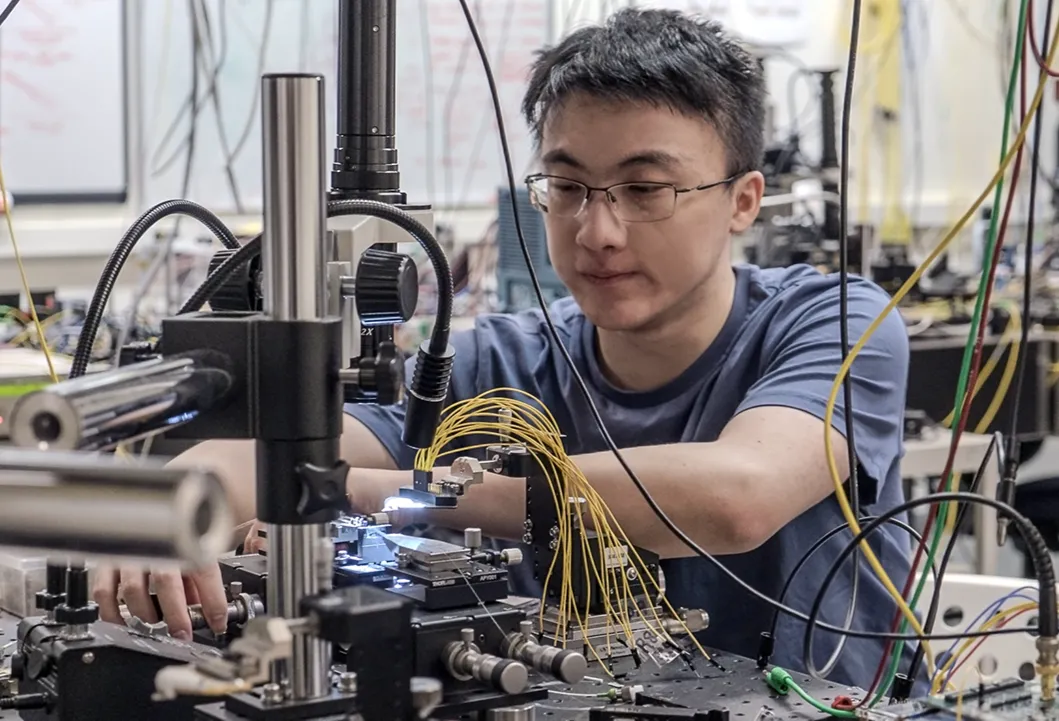
PhD Student Songli Wang was interviewed by Columbia Engineering about his summer 2024 internship at Intel, where he worked in their Silicon Photonics Research Team, researching silicon photonic switch designs. In the interview, Wang said: “It was incredibly rewarding to see my contributions directly align with the team’s objectives and make a tangible impact on the project”.
In summer 2025, Songli will be interning at NVIDIA.
Vignesh Gopal has successfully defended his thesis, "Application Specific Silicon Photonic Integrated Circuits". Dr. Gopal will next be heading to work at Beacon Photonics. Congratulations!
Stuart Daudlin has successfully defended his thesis, "Energy Efficient and High Density Integrated Photonic Transceivers". Dr. Daudlin will be continuing his work at LRL as a postdoctoral researcher. Congratulations!
At the inaugural annual review of Columbia Engineering’s Center for Ubiquitous Connectivity (CUbiC), held June 27-28, faculty, students, researchers, industry experts, and government officials convened to discuss new and ongoing research and share insights, fostering collaboration and driving advancements in the field of ubiquitous connectivity. Attended by about 115 in-person guests and additional participants who joined virtually, the two-day event at Columbia’s Morningside campus delved into three research themes: connectivity networks and systems, wireline and lightwave interconnects,…
Maarten Hattink has successfully defended his thesis and received his PhD. We wish him the best with his future endeavors!
In a study published today in Nature Photonics, researchers at Columbia Engineering demonstrate an energy-efficient method for transferring larger quantities of data over the fiber-optic cables that connect the nodes. This new technology improves on previous attempts to transmit multiple signals simultaneously over the same fiber-optic cables. Instead of using a different laser to generate each wavelength of light, the new chips require only a single laser to generate hundreds of distinct wavelengths of light that can simultaneously transfer independent streams of data. …