
Songli Wang has successfully defended his thesis entitled "Kerr-Comb-Driven Silicon Photonic Links for Co-Packaged Optics". Dr. Wang will next be heading to work at Nvidia. Congratulations and good luck in your new position!
Prof. Bergman was quoted in a recent Scientific American article discussing the explosive growth of the High-Bandwidth Memory (HBM) chip industry.
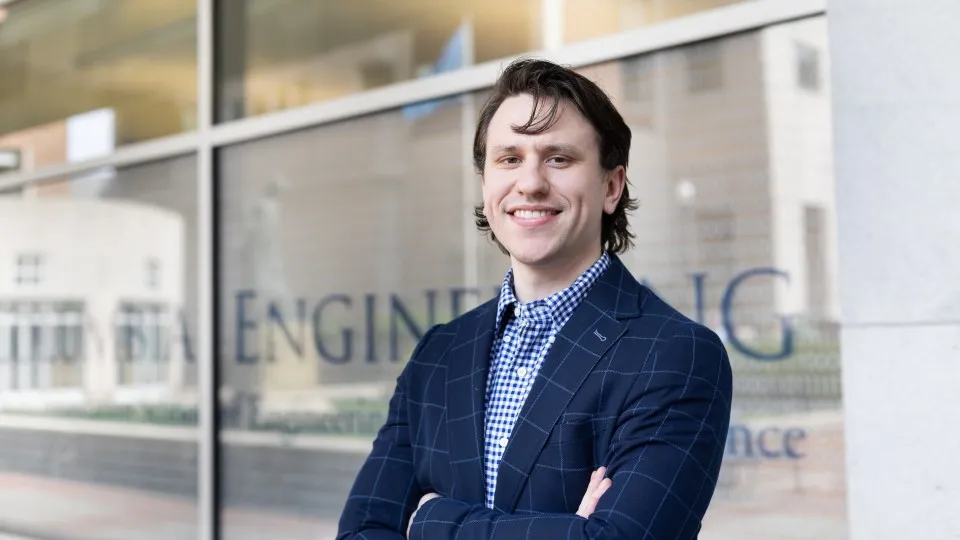
PhD student Michael Cullen was recently the feature of an article by Columbia Engineering, where he described his work on MCM modules and how his PhD work has expanded his skills. “People think that PhD life is only about research,” he says. “In reality, you become a graphic designer, a software developer, a public speaker, a grant writer, and you travel for conferences, build connections, give lab tours, and mentor younger students.”
Prof. Bergman was interviewed for a second time by insideHPS's @HPCpodcast to discuss the newest developments in silicon photonics and co-packaged optics. In the interview, Prof. Bergman "provides her forecast for commercial viability and also the practical impact of silicon photonics on chip and server performance and on data center cooling."
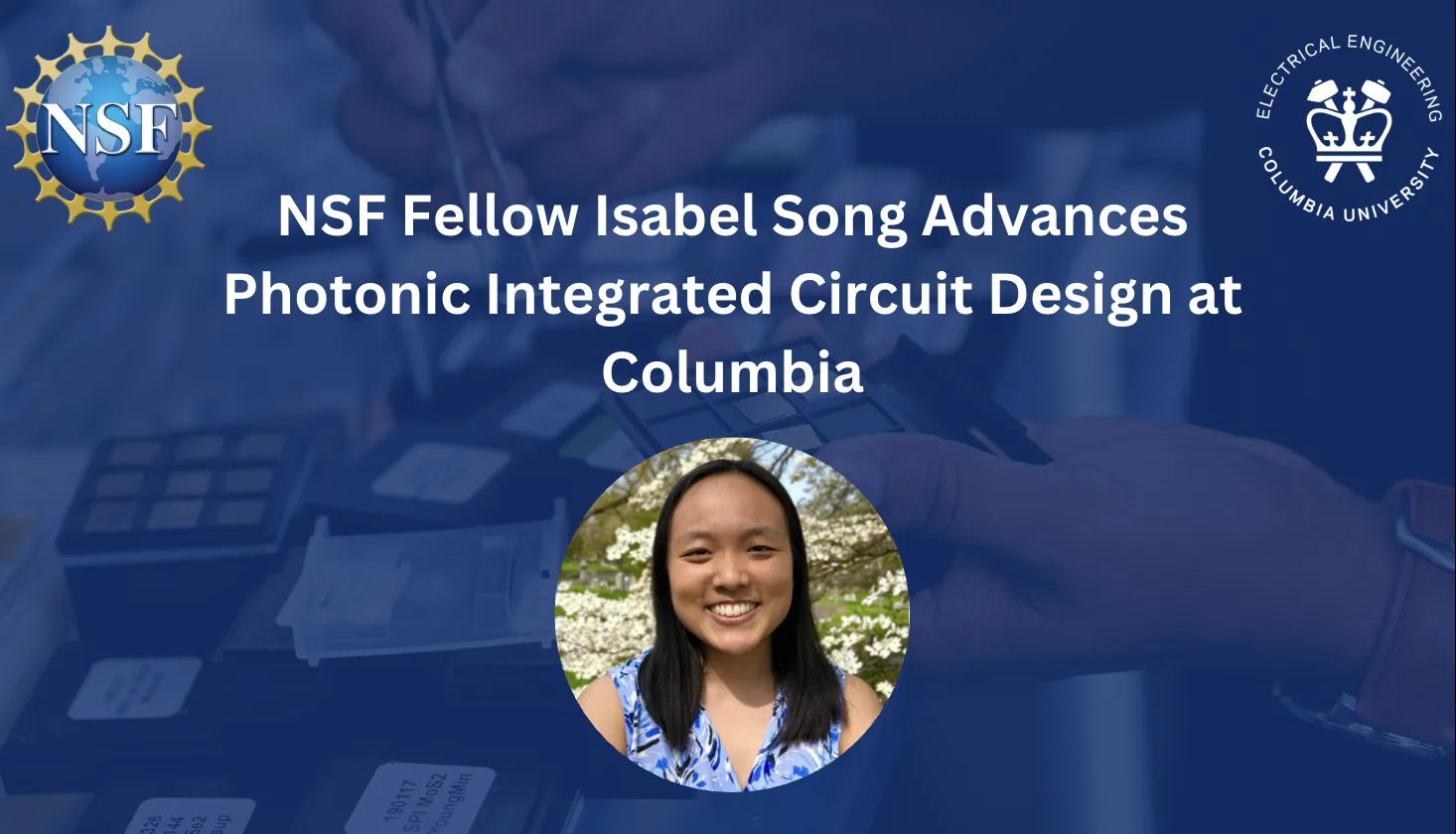
PhD student Isabel Song was recently featured in an article by the Department of Electrical Engineering highlighting her National Science Foundation (NSF) Graduate Research Fellowship and Wei Family Private Foundation Fellowship. She discussed her interest in silicon photonic integrated circuit design. “With photonic technologies playing an increasingly central role in high-performance computing and communications,” she said in the interview, “I want my research to contribute to building systems that are not only faster, but also more sustainable and energy-efficient.”
Robert Parsons has successfully defended his thesis, "Co-optimization of Silicon Photonic Link Architectures and Devices". Best wishes to him on the next phase of his career!
We are pleased to share that postdoctoral scientist Dr. Yuyang Wang has accepted a position as an Assistant Professor of Electrical Engineering at the University of Connecticut. We wish him all the best, and look forward to future collaborations!
Zhenguo "Brian" Wu has successfully defended his thesis, "Flexible Photonic Accelerated High Performance Compute System". Dr. Wu will next be heading to work at Nvidia. We wish him the best with his future endeavors!
James Robinson has successfully defended his thesis, "Applied Performance, Variation, and Control of Silicon Photonic Micro-Resonators and Links". Dr. Robinson will next be heading to work at the Naval Surface Warfare Center, Dahlgren Division. Congratulations and good luck in your new position!
The Center for Ubiquitous Connectivity (CUbiC) hosted its third annual review at Columbia University on June 25–26, 2025. Members of the Lightwave Research Group presented research and provided laboratory demos for colleagues in the center and industry sponsors.
Columbia Engineering featured an article about our recent Nature Photonics paper “3D Photonics for Ultra-Low Energy, High Bandwidth-Density Chip Data Links”. In this paper, the Lightwave Research Group demonstrated "a 3D photonic-electronic platform that achieves unprecedented energy efficiency and bandwidth density, paving the way for next-generation AI hardware."
We reported a bandwidth of 800 Gb/s, with an energy consumption of only 120 femtojoules per bit. The package achieves a bandwidth density of 5.3 Tb/s/mm², which exceeds the current state-of-the-art.